Opal is at Gartner IAM Summit, Dec 7 to 9 in Las Vegas.

Govern AI agents. agent.ID, Nov 5

Let’s meet.

Watch now.

Platform

Customers

Resources

Platform

Customers

Resources

Introducing Bundles

Product

0

1

Today, we are announcing the launch of bundles, simplifying employee onboarding.

Opal’s app catalog enables employees to request time-bounded applications via Slack or in the web. However, new employees might not know what they need. Using Bundles, managers and admins can now curate collections of resources and groups that are useful for employees.  Employees can use Opal to see what is relevant for them and bulk request for what they need.

Employees can easily browse collections of bundles when they onboard to the company.
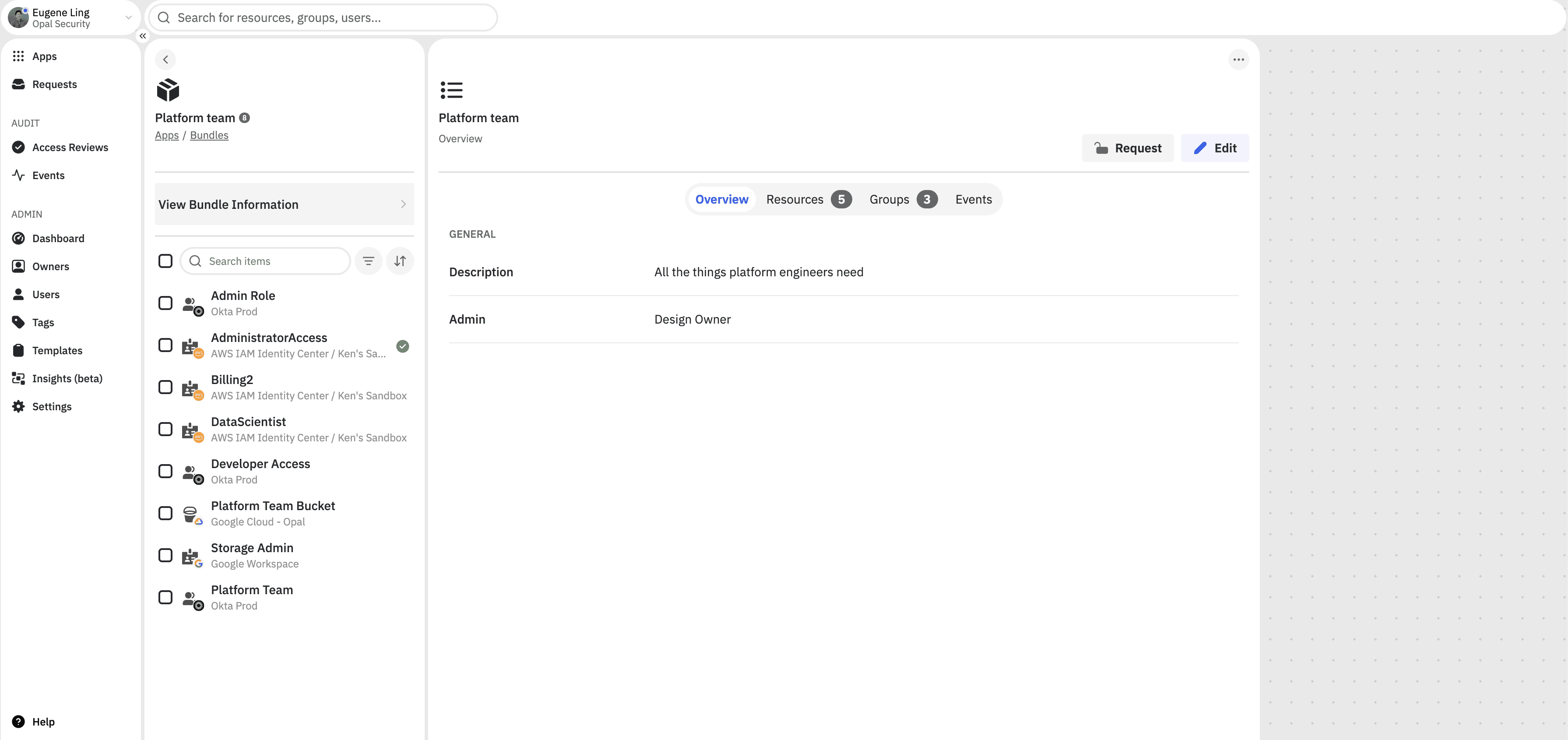
Employees can easily browse collections of bundles when they onboard to the company.

After browsing the collection, they can easily request for the necessary permissions. This can also be completed via Slack!

After browsing the collection, they can easily request for the necessary permissions. This can also be completed via Slack!

For admins, setting up bundles is fast and secure by design. With Opal, governance and security policies can be applied on specific permissions. Based on the risk profile of the permission, admins can configure policies such as multi-stage approvals, maximum duration, default visibility, second-factor authentication, and more. Resources and groups that are added to bundles all follow the same policies. This enables security teams to ensure that resources have the same access policies regardless of how employees request for them.
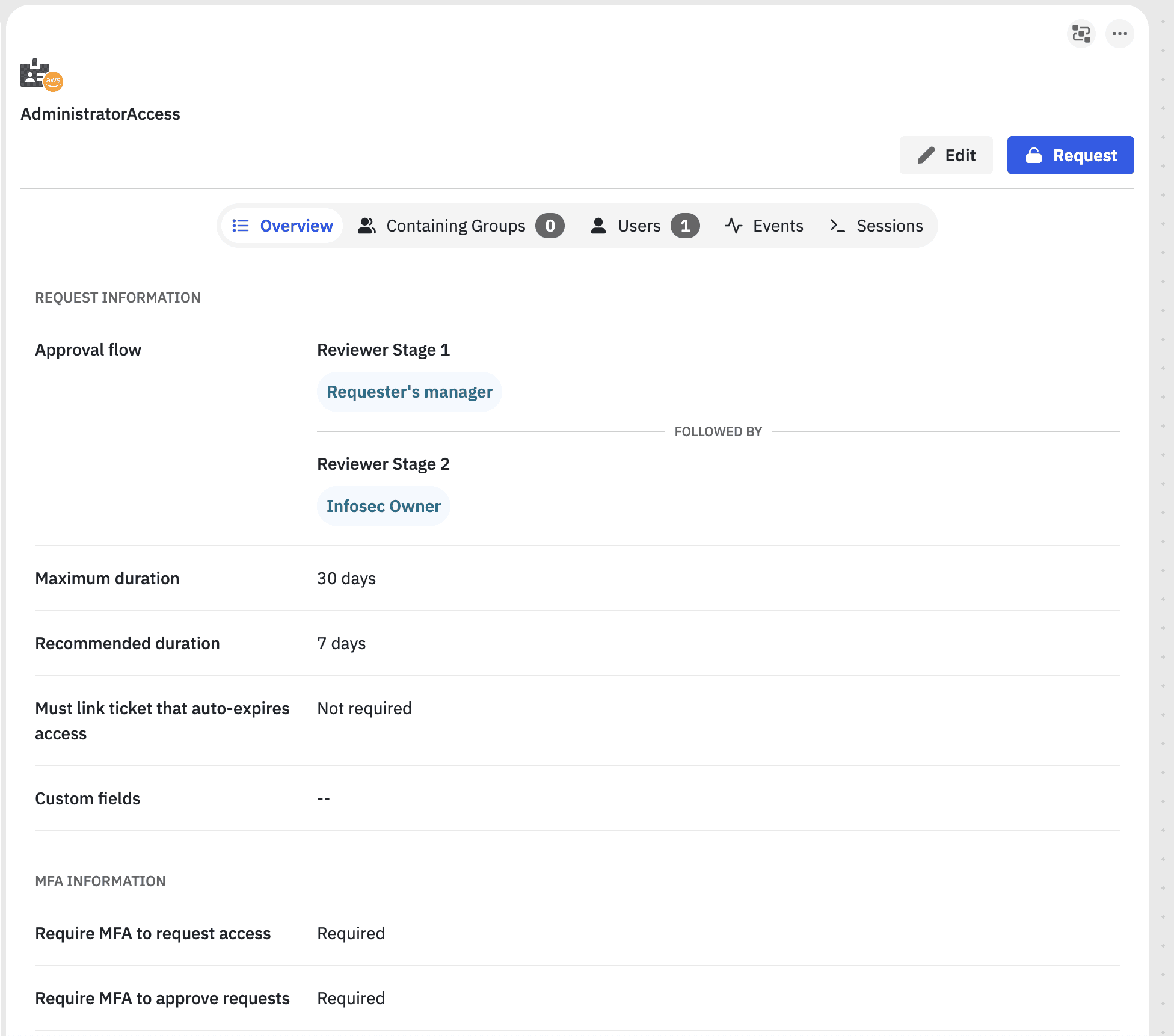
For admins, setting up bundles is fast and secure by design. With Opal, governance and security policies can be applied on specific permissions. Based on the risk profile of the permission, admins can configure policies such as multi-stage approvals, maximum duration, default visibility, second-factor authentication, and more. Resources and groups that are added to bundles all follow the same policies. This enables security teams to ensure that resources have the same access policies regardless of how employees request for them.

About Opal

Opal is the unified identity platform for modern enterprises. Opal aggregates identity and access data to provide visibility and defense-in-depth infrastructure for mission-critical systems. Enterprises can discover anomalous identity risks with the product and remediate them in minutes. The world's best companies trust Opal to govern and adapt sensitive access.

Want to see it yourself? Contact sales@opal.dev or book a meeting here for a personalized demo.

AI that makes continuous access decisions, with you on the dial.

AI that makes continuous access decisions, with you on the dial.

AI that makes continuous access decisions, with you on the dial.

Everything you need to know about Opal

What is Opal Security and what does it do?

Opal Security is an AI-native access platform that secures access for every identity in the enterprise, from employees and contractors to service accounts and AI agents. Security and engineering teams use Opal to grant just-in-time access, enforce least privilege, automate access reviews, and remediate identity risk in real time. Companies like Databricks, Figma, and Cloudflare run Opal to govern sensitive access.

What systems does Opal integrate with?

Opal integrates with the systems engineers and security teams already use, including Okta, AWS, GCP, Azure, GitHub, Snowflake, Databricks, Salesforce, Kubernetes, databases, and Slack. It connects to your identity provider to import users and groups, then layers granular, resource-level access control on top. Access requests and approvals can run directly in Slack.

How is Opal different from traditional IGA and IAM tools?

Legacy IGA tools mostly give you visibility and periodic reviews. Opal is a modern access platform with read-write enforcement, so it does not just surface excess access, it removes standing privilege and grants just-in-time access automatically.

Can Opal govern AI agents and non-human identities?

Yes. Opal governs non-human identities, including AI agents, service accounts, and machine identities, with the same least-privilege and just-in-time controls it applies to people. Agents can call Opal for access decisions with human oversight, and every action is logged in an audit trail, so you can see exactly what an agent did with its access.

Does Opal replace my existing identity stack?

No. Opal works on top of your existing identity stack rather than replacing it. It integrates with providers like Okta and your cloud and SaaS systems, adding granular authorization and just-in-time access without ripping out what you already run.

How fast can Opal be deployed?

Opal connects to your identity provider and core systems through native integrations, so teams typically see access visibility and working just-in-time workflows in days, not the multi-month rollouts associated with legacy IGA. You can start with a single high-risk system and expand from there.

Who is Opal's leadership?

Opal is led by CEO Howard Ting, who joined in December 2025 after serving as CEO of Cyberhaven and holding senior roles at Nutanix, Palo Alto Networks, and Redis. He has since expanded the executive team with Chief Product Officer Sameer Mehta, previously at Veza, and Chief Technology Officer Alex Pien. Opal has raised $59 million in total funding, including a recent $23 million round led by Greylock and Battery Ventures, and is used by security and engineering teams at companies like Databricks, Notion, Cloudflare, and CoreWeave.

0

FAQ

See. Encode.

→ Enforce.

© 2026

See. Encode.

→ Enforce.

© 2026

See.

→ Enforce.

Encode.

© 2026