Opal is at Gartner IAM Summit, Dec 7 to 9 in Las Vegas.

Govern AI agents. agent.ID, Nov 5

Let’s meet.

Watch now.

Platform

Customers

Resources

Platform

Customers

Resources

Introducing Opal ↔︎ Snowflake Integration: Managing Granular Access to Critical Data

Shelley Wu

Shelley Wu

Product

0

1

The Challenge

As enterprises expand their data footprint in the cloud, securing access to sensitive, business-critical information in processing, warehousing, and analytics platforms like Snowflake becomes more important than ever. Snowflake’s powerful and flexible Access Controls Framework allows administrators to set granular permission scopes with a high degree of customizability. However, at scale, this also means administrators must be equipped to manage complex access patterns that come with elaborate organizational policies. To enforce least privilege access to these systems and maintain regulatory compliance, Security, Infrastructure, and IT teams are often tasked to understand: who has access to a Snowflake Database? Which users have implicit access to a Snowflake Role? Which users have access to what Databases, Schemas, and Tables, and how long have they had access for? These teams not only have to be able to quickly gain context and certify access, but they also have to be able to proactively rightsize permissions and delegate approval flows while adapting to business needs and employee lifecycle changes.


The Opal ↔︎ Snowflake Integration

Opal built this integration to help customers answer key access questions and implement least privilege in their Snowflake environments. With this integration, teams can:

  • Quickly set up and connect Opal ↔︎ Snowflake

  • Import and sync Snowflake Roles and Securable Objects into Opal

  • Manage which users have access to a Snowflake Role (direct & indirect)

  • View which Securable Objects (e.g. Snowflake Databases, Schemas, Tables) a Role has access to 

  • Manage which users have access to Securable Objects

  • View granular privileges granted to each user and Role

  • Perform a User Access Review (UAR) on users with direct access to a Snowflake Role

  • Empower end users throughout the company to request JIT access to a Snowflake Role

  • Delegate access review and approval decisions to appropriate teams that have context around the data

__wf_reserved_inherit__wf_reserved_inherit


Key Benefits

  • Simplify access: At a glance, administrators can understand which users have access to Snowflake Roles and Securable Objects and assess their security posture.

  • Reduce Risk: Quickly remediate on roles that are overprovisioned. For resources that contain PII or extra sensitive data, customers can easily remove users who do not require access or convert long standing to JIT access.‍

  • Enable self-service: Employees across the organization can self-service and request time-bound access to Snowflake Roles that grant them the appropriate access to datasets they need for their job. Administrators can customize request configurations and approval workflows to ensure only the necessary access gets granted.


How It Works

  • Importing a Securable Object like a Table will automatically create a resource hierarchy, making it easy to visualize the parent Schema and Database in Opal. Admins can choose to import only a select Snowflake Role, or automatically import it along with all the Securable Objects it has access to.

__wf_reserved_inherit
  • Admins can view the Privileges a user has to a Securable Object, how the access was obtained, and length of access. In this example, they can see that four users have access to the Customer Snowflake Table, and specifically, that Tommy Boyer has the ability to execute SELECT queries on the table by virtue of having access to the Parent Snowflake Role.

__wf_reserved_inherit__wf_reserved_inherit
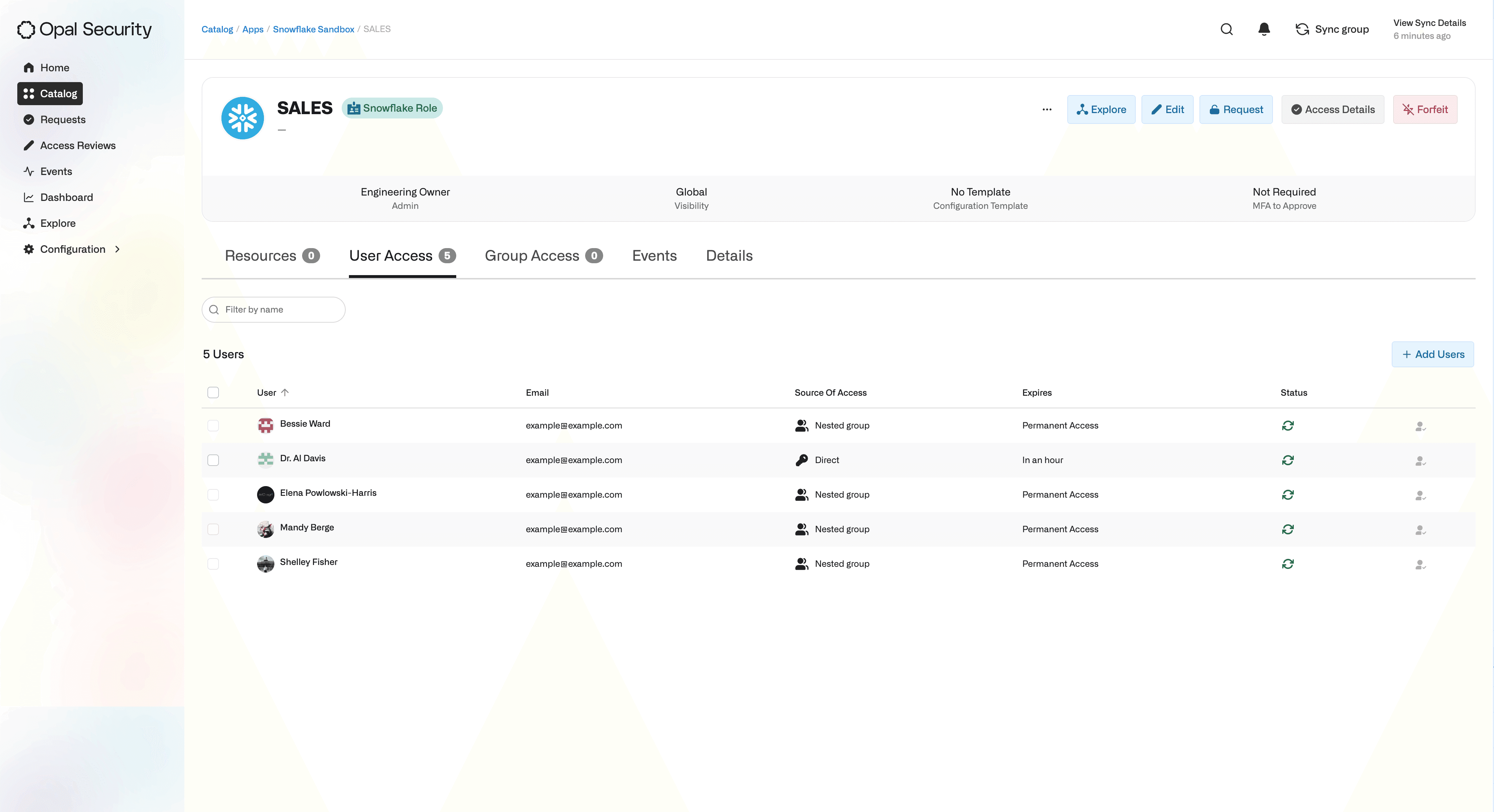
  • Admins can remove users with direct access to a Snowflake Role. As an example, an Opal Admin may notice that Marty Klocko, an Engineer, should not have access to the Sales Snowflake Role. The admin can quickly remove Marty’s access or separately navigate to the Events section to understand how and why Marty was granted access to the role.

__wf_reserved_inherit
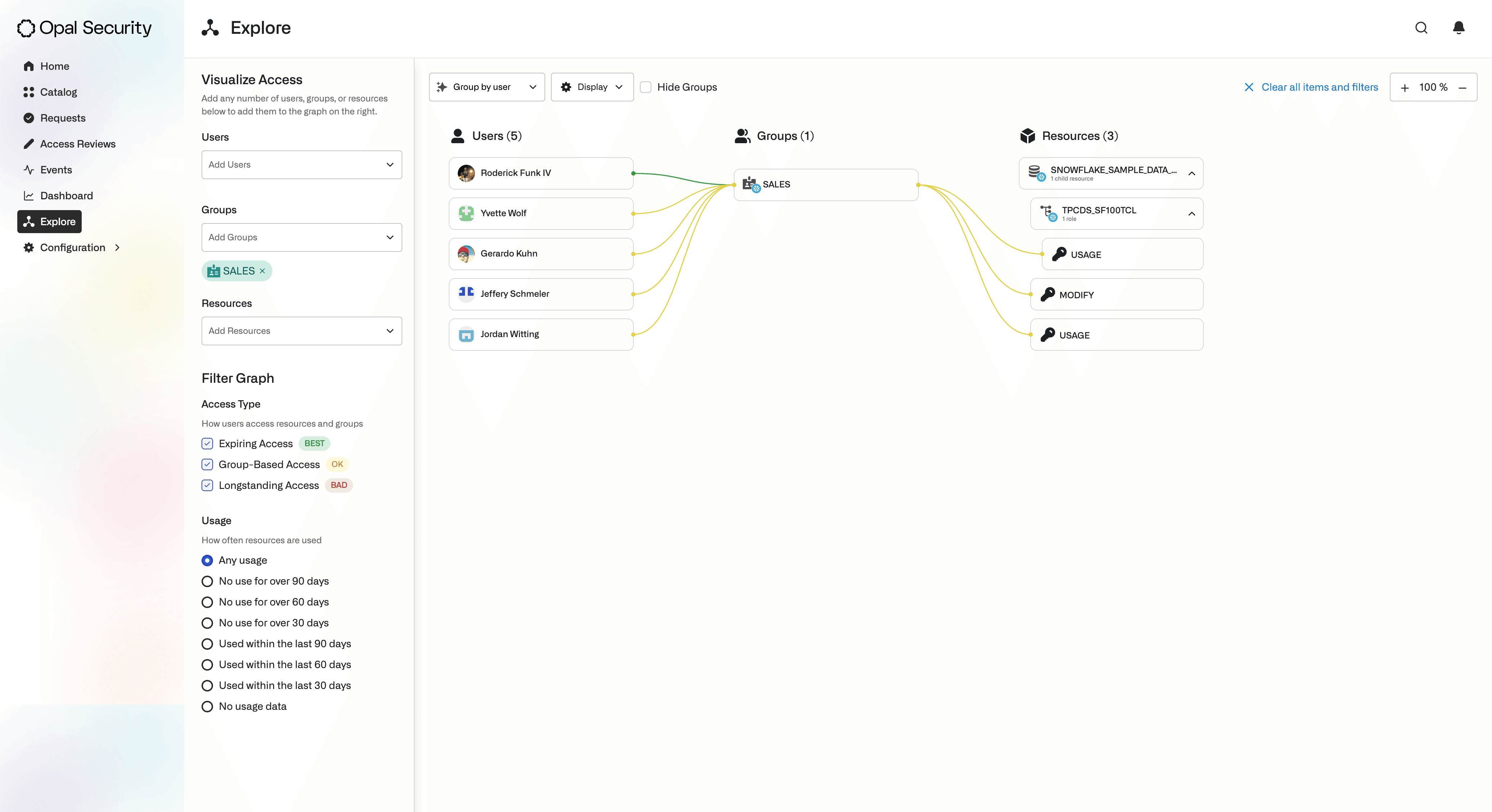
  • Admins can use the Explore view to easily visualize access relationships, as they can with other Opal integrations. By simply selecting the Sales Snowflake Role, an admin can see both the list of users with access to the Snowflake Role, as well the Database, Schema, Table resources the Snowflake Role grants access to.
__wf_reserved_inherit
  • End users can request JIT access to a Snowflake Role. In this example, analyst Sonie Beahan, needs access to the Customer Snowflake Table to perform an investigation. Sonie can use Opal to request 1-hour access to the Sales Snowflake Role, and once their request is approved by the Sales Team Manager, Sonie will have the necessary access. After an hour, Sonie’s access will automatically expire unless extended.

__wf_reserved_inherit


How to Use the Snowflake Integration

The Opal ↔︎ Snowflake integration is available in Beta for all Opal Security customers. Interested customers can contact their Technical Account Manager to enable this feature.

About Opal Security

Opal Security is redefining identity security for modern enterprises. The unified platform aggregates identity and access data to provide customers with visibility and rapid control to protect mission-critical systems while accommodating the complexity and agility businesses require for growth. IT and security teams can discover anomalous identity risks and remediate them in minutes. Many global leaders, including Databricks, Figma and Scale AI, trust Opal Security to enable them to govern and adapt sensitive access quickly and securely.

AI that makes continuous access decisions, with you on the dial.

AI that makes continuous access decisions, with you on the dial.

AI that makes continuous access decisions, with you on the dial.

Everything you need to know about Opal

What is Opal Security and what does it do?

Opal Security is an AI-native access platform that secures access for every identity in the enterprise, from employees and contractors to service accounts and AI agents. Security and engineering teams use Opal to grant just-in-time access, enforce least privilege, automate access reviews, and remediate identity risk in real time. Companies like Databricks, Figma, and Cloudflare run Opal to govern sensitive access.

What systems does Opal integrate with?

Opal integrates with the systems engineers and security teams already use, including Okta, AWS, GCP, Azure, GitHub, Snowflake, Databricks, Salesforce, Kubernetes, databases, and Slack. It connects to your identity provider to import users and groups, then layers granular, resource-level access control on top. Access requests and approvals can run directly in Slack.

How is Opal different from traditional IGA and IAM tools?

Legacy IGA tools mostly give you visibility and periodic reviews. Opal is a modern access platform with read-write enforcement, so it does not just surface excess access, it removes standing privilege and grants just-in-time access automatically.

Can Opal govern AI agents and non-human identities?

Yes. Opal governs non-human identities, including AI agents, service accounts, and machine identities, with the same least-privilege and just-in-time controls it applies to people. Agents can call Opal for access decisions with human oversight, and every action is logged in an audit trail, so you can see exactly what an agent did with its access.

Does Opal replace my existing identity stack?

No. Opal works on top of your existing identity stack rather than replacing it. It integrates with providers like Okta and your cloud and SaaS systems, adding granular authorization and just-in-time access without ripping out what you already run.

How fast can Opal be deployed?

Opal connects to your identity provider and core systems through native integrations, so teams typically see access visibility and working just-in-time workflows in days, not the multi-month rollouts associated with legacy IGA. You can start with a single high-risk system and expand from there.

Who is Opal's leadership?

Opal is led by CEO Howard Ting, who joined in December 2025 after serving as CEO of Cyberhaven and holding senior roles at Nutanix, Palo Alto Networks, and Redis. He has since expanded the executive team with Chief Product Officer Sameer Mehta, previously at Veza, and Chief Technology Officer Alex Pien. Opal has raised $59 million in total funding, including a recent $23 million round led by Greylock and Battery Ventures, and is used by security and engineering teams at companies like Databricks, Notion, Cloudflare, and CoreWeave.

0

FAQ

See. Encode.

→ Enforce.

© 2026

See. Encode.

→ Enforce.

© 2026

See.

→ Enforce.

Encode.

© 2026