Platform

Customers

Resources

Platform

Customers

Resources

Scaling and Automating Identity Security with Opal and Tines

Shelley Wu

Shelley Wu

Product

0

1

As enterprises grow and modernize their technology stacks, protecting unauthorized access to critical applications and data across the cloud and on-prem becomes more important than ever. Major cloud providers like AWS, GCP, Azure and SaaS tools like Github, Salesforce, Slack are all sources containing rich troves of sensitive data. A company’s ability to appropriately grant and revoke fine-grained access to such systems for an ever-evolving workforce directly impacts its ability to maintain a strong Identity Security posture. While Security, IT, and Infrastructure teams do their best to define and implement least privilege, managing this at scale is almost impossible due to the speed and complexity of businesses today. 

‍

To tackle this, Opal and Tines are partnering to help teams protect and manage access to their critical resources in an automated fashion. 

  • With Opal’s data-centric identity platform that integrates seamlessly into an organization’s application ecosystem, teams can easily gain visibility on who has access to what, feel empowered to delegate access policies, and swiftly remediate overprovisioned access .

  • With Tines’ intuitive and powerful automation platform and extensive repertoire of event-based templates, teams can swiftly operationalize the repeatable, high-overhead tasks that often cause burnout or friction between organizations. 

Used in combination, Opal and Tines can help provide direct access management and remediation capabilities easily, effectively, and efficiently.

‍

Sample Opal x Tines Use Cases

To get started, we’ve put together a few common use cases we’ve seen customers employ:

Use case 1: Alerting on anomalous access behavior
In this use case, customers can track access requests in Opal, and if the content of the requests meet specific conditions, Tines creates a Tines case to investigate the access requests.

‍

Use case 2: Adding a new team member automatically to a group or resource and tracking the change in a ticketing system
In this use case, customers can create a Tines trigger against a “New Hire” event from their HRIS of choice, automatically add the user to the desired Opal-managed group or resource, and generate a Jira ticket to record the change.
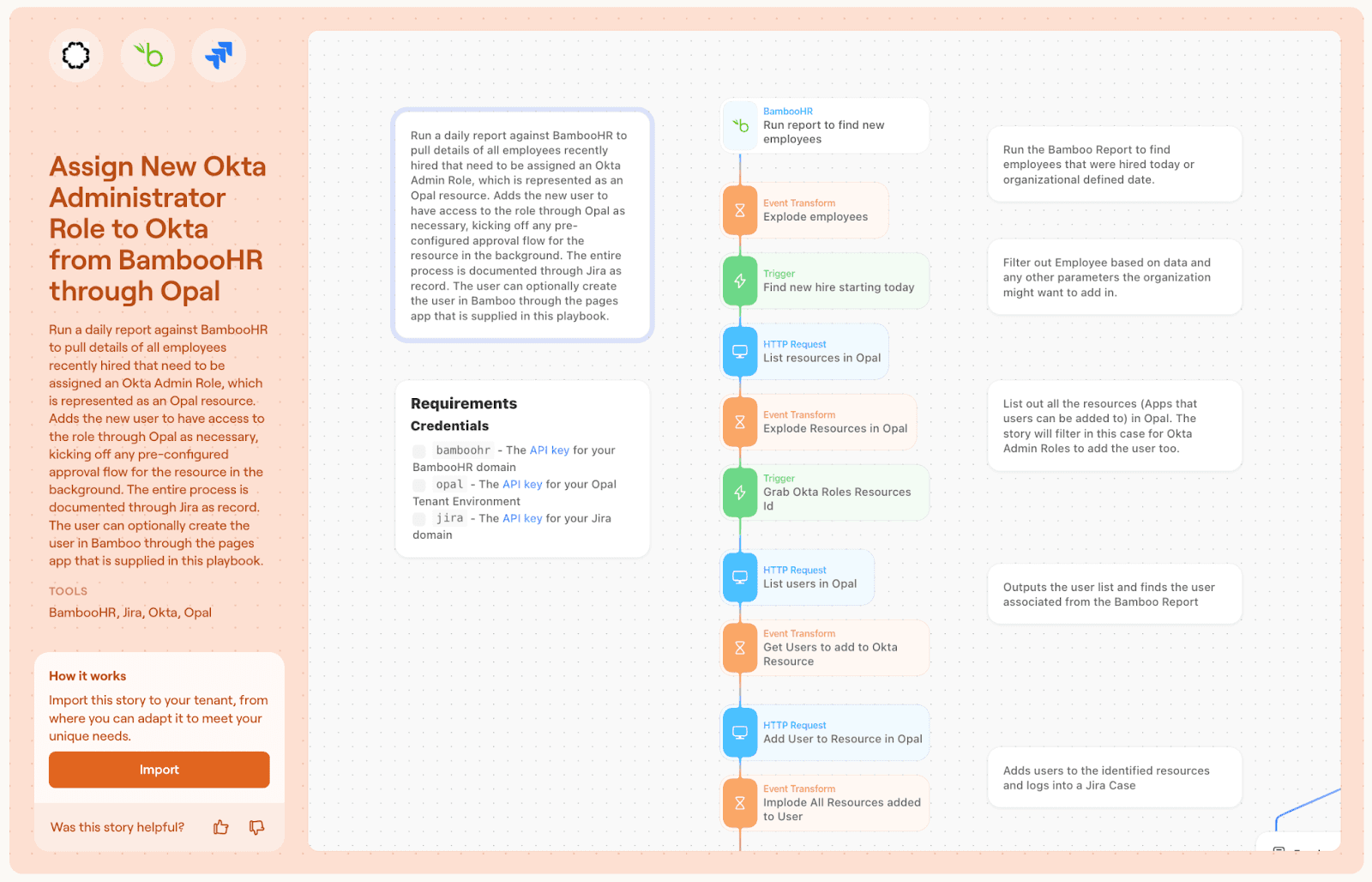
At Opal, we’re dedicated to ensuring that our customers have the tools they need to securely manage access to their applications and data from day one, and we look forward to building and sharing more use cases with the community. 

‍

Benefits of Opal x Tines:

  • Scalable Implementation of Least Privilege: Opal provides holistic visibility, actionability, and control over a customer’s Identity Security posture while Tines helps connect the dots with flexible and proactive automation stories. 

  • Seamless, low-effort integration with existing tooling and workflows: Opal and Tines work with a variety of end systems to link together events, triggers, and access data for quick remediation capabilities.

  • Reduced manual overhead on repetitive access tasks: The days of manually managing access against a sprawling set of resources and manually creating change management tickets are limited with this powerful combination of access data and automation.

Learn More

Try Opal and Tines out today to start securing your identity perimeter at scale. If you would like to learn more about how Opal can help your team in this journey, don’t be shy and reach out to us at: hello@opal.dev.

AI that makes continuous access decisions, with you on the dial.

AI that makes continuous access decisions, with you on the dial.

AI that makes continuous access decisions, with you on the dial.

Everything you need to know about Opal

What is Opal Security and what does it do?

Opal Security is an AI-native access platform that secures access for every identity in the enterprise, from employees and contractors to service accounts and AI agents. Security and engineering teams use Opal to grant just-in-time access, enforce least privilege, automate access reviews, and remediate identity risk in real time. Companies like Databricks, Figma, and Cloudflare run Opal to govern sensitive access.

What systems does Opal integrate with?

Opal integrates with the systems engineers and security teams already use, including Okta, AWS, GCP, Azure, GitHub, Snowflake, Databricks, Salesforce, Kubernetes, databases, and Slack. It connects to your identity provider to import users and groups, then layers granular, resource-level access control on top. Access requests and approvals can run directly in Slack.

How is Opal different from traditional IGA and IAM tools?

Legacy IGA tools mostly give you visibility and periodic reviews. Opal is a modern access platform with read-write enforcement, so it does not just surface excess access, it removes standing privilege and grants just-in-time access automatically.

Can Opal govern AI agents and non-human identities?

Yes. Opal governs non-human identities, including AI agents, service accounts, and machine identities, with the same least-privilege and just-in-time controls it applies to people. Agents can call Opal for access decisions with human oversight, and every action is logged in an audit trail, so you can see exactly what an agent did with its access.

Does Opal replace my existing identity stack?

No. Opal works on top of your existing identity stack rather than replacing it. It integrates with providers like Okta and your cloud and SaaS systems, adding granular authorization and just-in-time access without ripping out what you already run.

How fast can Opal be deployed?

Opal connects to your identity provider and core systems through native integrations, so teams typically see access visibility and working just-in-time workflows in days, not the multi-month rollouts associated with legacy IGA. You can start with a single high-risk system and expand from there.

Who is Opal's leadership?

Opal is led by CEO Howard Ting, who joined in December 2025 after serving as CEO of Cyberhaven and holding senior roles at Nutanix, Palo Alto Networks, and Redis. He has since expanded the executive team with Chief Product Officer Sameer Mehta, previously at Veza, and Chief Technology Officer Alex Pien. Opal has raised $59 million in total funding, including a recent $23 million round led by Greylock and Battery Ventures, and is used by security and engineering teams at companies like Databricks, Notion, Cloudflare, and CoreWeave.

0

FAQ

See. Encode.

→ Enforce.

© 2026

See. Encode.

→ Enforce.

© 2026

See.

→ Enforce.

Encode.

© 2026