Top Security Leaders on Governing AI Agents. Now available on-demand at agent.id.

Govern AI agents. agent.ID, Nov 5

Watch now.

Watch now.

Platform

Customers

Resources

Platform

Customers

Resources

πŸŽ‰ We Have a New Website!

Profile Icon

Staff

Product

0

1

Chugga-chugga choo choo! All aboard the Opal Express!

Today we've got four exciting sightseeing stops for you to check out. So take a quick break from the busy workday and come with us...

To Opal's brand new website!

What's so exciting, you say? Well, the website re-launch is more than just a makeoverβ€”it also represents a strategic step towards a bold future.

Instead of just focusing on developer permissions, we're now equipped to handle any permissions across the company, including features that allow granular database access control, segregation of duty policies, and integrations with your internal tools.

We've been hard at work building the features that make it easier for our customers, expanding Opal's feature set as the most intelligent, secure, and easy-to-use platform for accessing engineering infrastructure.

Here are a few destinations on the new website you don't want to miss...

1. Benefits

First, we've highlighted the benefits of using Opal for Compliance, DevOps Teams, Engineering, and Security Teams!

Check out the new animations showing Opal in action! (spoiler: there's confetti involved!)

2. Use Cases

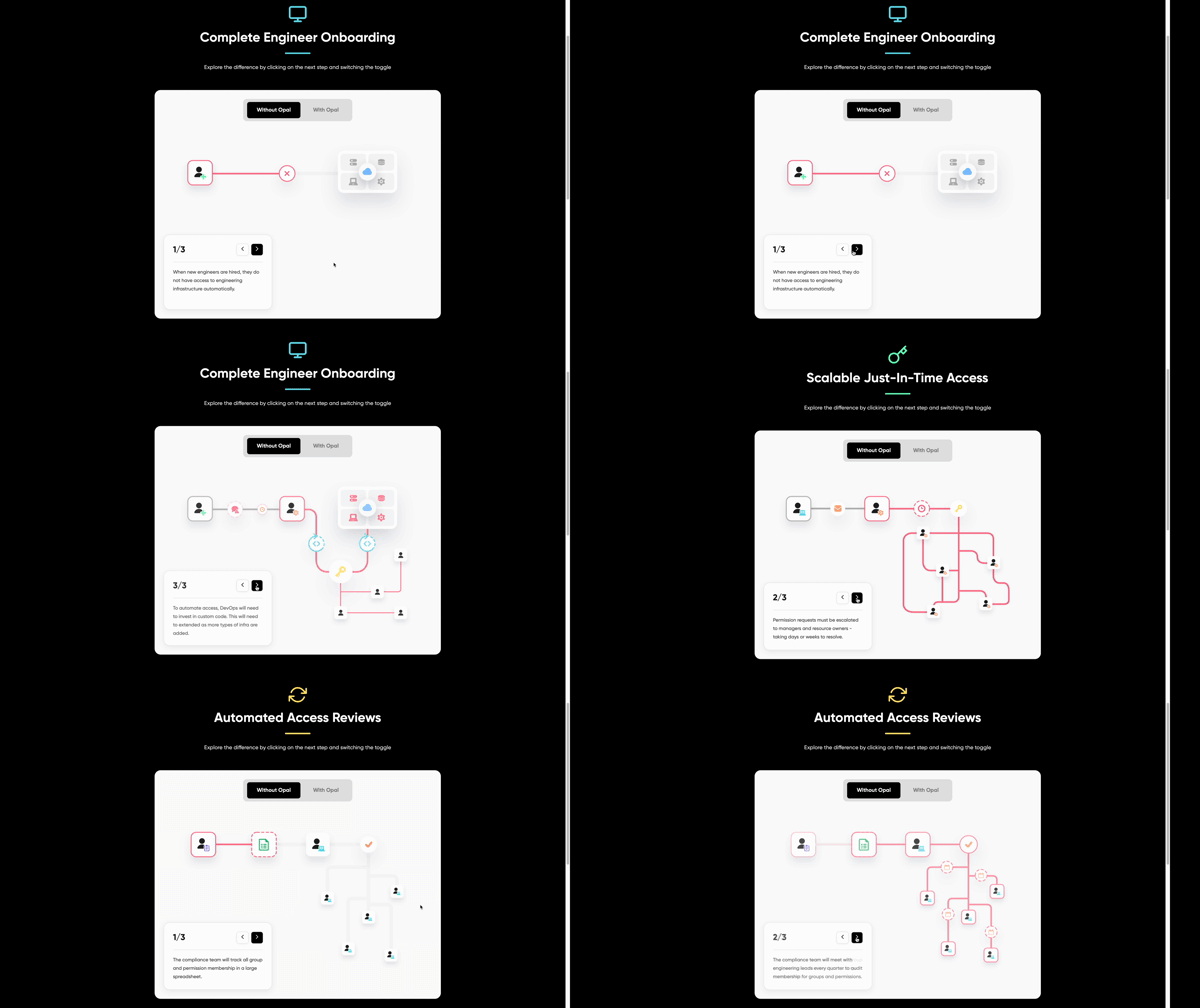
Second, we've expanded our use cases to manage engineer onboarding, scalable just-in-time access, and self-serve access reviews.
‍

3. Integrations

We're obsessed with delivering value to our customers, which leads me to stop number three: Integrations!

The website is now a one-stop-shop where you can peruse all of Opal's integrations at your leisure! This includes Slack, AWS, Google Groups, and many more. Check it out below, or head over to see how you can use Opal to simplify your Engineering workflow.

4. Security

Last, we've added a page to highlight our dedication to what Opal is known for: Security!

Built using AES 256-bit encryption and straight-A marks on our SOC 2 report, Opal supports both self-hosted and SaaS deployment options. Read more about security at Opal.

‍

‍

That's it for now! Thanks for coming along for the ride. We have lots of exciting new features coming down the pipeline, and we can't wait to share them.

Which feature were you most excited about? Shoot us an email at hello@opal.dev or visit our website: https://opal.dev/

AI that makes continuous access decisions, with you on the dial.

AI that makes continuous access decisions, with you on the dial.

AI that makes continuous access decisions, with you on the dial.

Everything you need to know about Opal

What is Opal Security and what does it do?

Opal Security is an AI-native access platform that secures access for every identity in the enterprise, from employees and contractors to service accounts and AI agents. Security and engineering teams use Opal to grant just-in-time access, enforce least privilege, automate access reviews, and remediate identity risk in real time. Companies like Databricks, Figma, and Cloudflare run Opal to govern sensitive access.

What systems does Opal integrate with?

Opal integrates with the systems engineers and security teams already use, including Okta, AWS, GCP, Azure, GitHub, Snowflake, Databricks, Salesforce, Kubernetes, databases, and Slack. It connects to your identity provider to import users and groups, then layers granular, resource-level access control on top. Access requests and approvals can run directly in Slack.

How is Opal different from traditional IGA and IAM tools?

Legacy IGA tools mostly give you visibility and periodic reviews. Opal is a modern access platform with read-write enforcement, so it does not just surface excess access, it removes standing privilege and grants just-in-time access automatically.

Can Opal govern AI agents and non-human identities?

Yes. Opal governs non-human identities, including AI agents, service accounts, and machine identities, with the same least-privilege and just-in-time controls it applies to people. Agents can call Opal for access decisions with human oversight, and every action is logged in an audit trail, so you can see exactly what an agent did with its access.

Does Opal replace my existing identity stack?

No. Opal works on top of your existing identity stack rather than replacing it. It integrates with providers like Okta and your cloud and SaaS systems, adding granular authorization and just-in-time access without ripping out what you already run.

How fast can Opal be deployed?

Opal connects to your identity provider and core systems through native integrations, so teams typically see access visibility and working just-in-time workflows in days, not the multi-month rollouts associated with legacy IGA. You can start with a single high-risk system and expand from there.

Who is Opal's leadership?

Opal is led by CEO Howard Ting, who joined in December 2025 after serving as CEO of Cyberhaven and holding senior roles at Nutanix, Palo Alto Networks, and Redis. He has since expanded the executive team with Chief Product Officer Sameer Mehta, previously at Veza, and Chief Technology Officer Alex Pien. Opal has raised $59 million in total funding, including a recent $23 million round led by Greylock and Battery Ventures, and is used by security and engineering teams at companies like Databricks, Notion, Cloudflare, and CoreWeave.

0

FAQ

See. Encode.

β†’ Enforce.

Β© 2026

See. Encode.

β†’ Enforce.

Β© 2026

See.

β†’ Enforce.

Encode.

Β© 2026