Top Security Leaders on Governing AI Agents. Now available on-demand at agent.id.
Govern AI agents. agent.ID, Nov 5
Watch now.
Watch now.
" width="9.333999999999946px"><path d="M 0 0 L 0 9.334" fill="transparent" height="9.334000000000003px" id="Ho_4eUERn" stroke-dasharray="" stroke-linecap="butt" stroke-linejoin="round" stroke-width="1.2" stroke="rgb(35, 41, 51)" transform="translate(4.5 0)" width="1px"/><path d="M 0 0 L 4.667 4.667 L 9.334 0" fill="transparent" height="4.667000000000002px" id="q4SooRAjE" stroke-dasharray="" stroke-linecap="square" stroke-linejoin="round" stroke-width="1.2" stroke="rgb(35, 41, 51)" transform="translate(0 4.5)" width="9.333999999999946px"/></g></svg>)

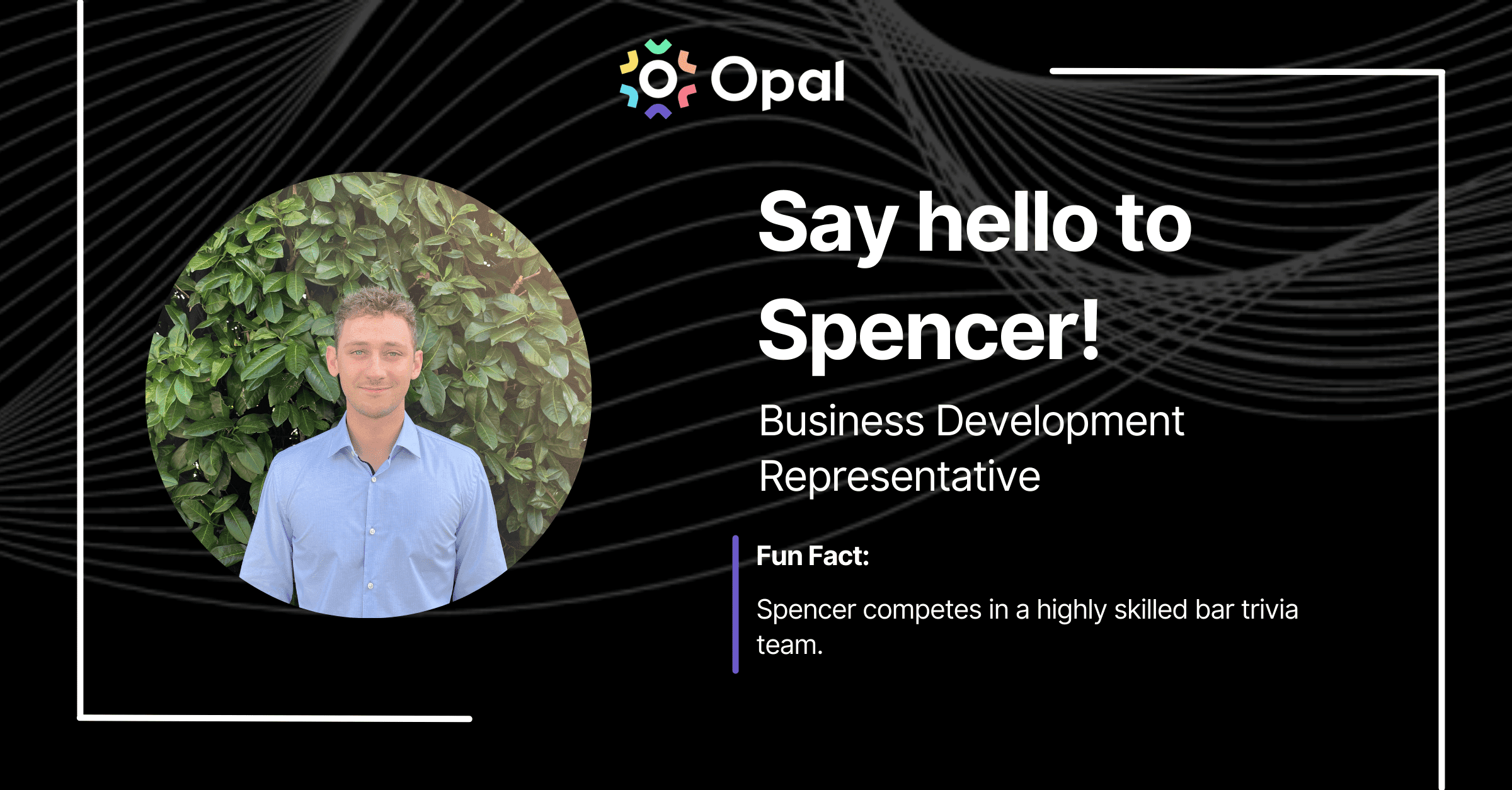
Let’s welcome Spencer, our latest BDR!
⭐ Why he joined Opal: “The culture seems very positive. The company, product, and industry are interesting, and I’m excited to grow my career here!”
⭐ About Spencer: Previously in tech sales as an SDR, he’s excited to bring his experience here to Opal. A Western Washington University alumni, Spencer is an avid skier and a regular at bar trivia night with a competitive team (his friends) that has yet to place first. It’s okay, Spence, you’ll get there! 😂
Excited to see the impact you’ll make here, Spencer! 🎉
Want to work at Opal? Check out our Careers page.
Explore more


0
3
AI that makes continuous access decisions, with you on the dial.
AI that makes continuous access decisions, with you on the dial.
AI that makes continuous access decisions, with you on the dial.
Everything you need to know about Opal
What is Opal Security and what does it do?
Opal Security is an AI-native access platform that secures access for every identity in the enterprise, from employees and contractors to service accounts and AI agents. Security and engineering teams use Opal to grant just-in-time access, enforce least privilege, automate access reviews, and remediate identity risk in real time. Companies like Databricks, Figma, and Cloudflare run Opal to govern sensitive access.
What systems does Opal integrate with?
Opal integrates with the systems engineers and security teams already use, including Okta, AWS, GCP, Azure, GitHub, Snowflake, Databricks, Salesforce, Kubernetes, databases, and Slack. It connects to your identity provider to import users and groups, then layers granular, resource-level access control on top. Access requests and approvals can run directly in Slack.
How is Opal different from traditional IGA and IAM tools?
Legacy IGA tools mostly give you visibility and periodic reviews. Opal is a modern access platform with read-write enforcement, so it does not just surface excess access, it removes standing privilege and grants just-in-time access automatically.
Can Opal govern AI agents and non-human identities?
Yes. Opal governs non-human identities, including AI agents, service accounts, and machine identities, with the same least-privilege and just-in-time controls it applies to people. Agents can call Opal for access decisions with human oversight, and every action is logged in an audit trail, so you can see exactly what an agent did with its access.
Does Opal replace my existing identity stack?
No. Opal works on top of your existing identity stack rather than replacing it. It integrates with providers like Okta and your cloud and SaaS systems, adding granular authorization and just-in-time access without ripping out what you already run.
How fast can Opal be deployed?
Opal connects to your identity provider and core systems through native integrations, so teams typically see access visibility and working just-in-time workflows in days, not the multi-month rollouts associated with legacy IGA. You can start with a single high-risk system and expand from there.
Who is Opal's leadership?
Opal is led by CEO Howard Ting, who joined in December 2025 after serving as CEO of Cyberhaven and holding senior roles at Nutanix, Palo Alto Networks, and Redis. He has since expanded the executive team with Chief Product Officer Sameer Mehta, previously at Veza, and Chief Technology Officer Alex Pien. Opal has raised $59 million in total funding, including a recent $23 million round led by Greylock and Battery Ventures, and is used by security and engineering teams at companies like Databricks, Notion, Cloudflare, and CoreWeave.
0
FAQ