Top Security Leaders on Governing AI Agents. Now available on-demand at agent.id.

Govern AI agents. agent.ID, Nov 5

Watch now.

Watch now.

Platform

Customers

Resources

Platform

Customers

Resources

How Opal Secures Internal Tools

Profile Icon

Staff

Resources

0

1

How Opal Secures Internal Tools

As companies grow, they often develop powerful admin tools so that customer-facing teams can support their users. Examples of these tools include impersonating customers and performing admin actions. While beneficial, they are also highly privileged. Especially in light of recent social engineering attacks, we take our customers’ trust very seriously. To protect our internal admin tool, we apply the following principles:

  1. Just-in-time access: Employees do not have long-standing access, and requests are just-in-time and fully audited

  2. Granular access: Access to the internal tool is highly scoped

  3. Time-bounded access: All access to the internal tool will automatically expire after 4 hours

  4. Authenticated approvals: Approvers must validate their identity using 2FA

  5. Audited controls: Audit and log all approvals.

Note: The screenshots below are not representative of our internal tool and are for illustrative purposes only.

To learn more about our custom connectors, please see our documentation.

1. Just-in-time access: Employees do not have long-standing access, and requests are just-in-time and fully audited

To help troubleshoot our customers, we have an internal tool that lets employees impersonate our customers in a Read-Only manner. Given the platform's sensitivity, Opal employees do not have long-lived access to the internal tool. All employees have to submit an access request to our security team.

2. Granular access: Access to the internal tool is highly scoped

Employees cannot request access to the impersonation tool in its entirety, and they must scope all requests to a specific user(s). In Opal, this maps to an Access Level. Granular access allows Opal to reduce the blast radius of a breach. If an attacker gets ahold of an employee’s credentials, exposure is limited to the granted access levels.

3. Time-bounded access: All access to the internal tool will automatically expire after 4 hours

In addition to access levels, all access requests to the internal tool have a maximum duration of 4 hours. After the employee starts their session, their access will automatically expire after 4 hours. Users will need to request extensions if they need additional time.

4. Authenticated approvals: Approvers must validate their identity using 2FA

Opal’s security team streamlines approvals by automatically notifying approvers via Slack. Since this is for a privileged request, Opal mandates that all approvers must complete a 2FA challenge first.

5. Audited controls: All approvals are audited

Opal audits every access request by default. For further visibility, access to internal tools - whether through Opal or not - will create a notification in a Slack channel.

How Opal integrates with your internal tool

We have built a powerful sync engine to orchestrate access workflows across cloud infrastructure, SaaS apps, and internal tools.

If customers implement our sync API REST specification, Opal can manage the tool as if it were any other third-party system with which Opal integrates. Opal will query your web service every hour or upon manual syncs to get an updated list of applications, resources, and access levels. Any updates pulled from your custom app will be reflected in the Opal UI. When a user is added or removed from a resource in Opal (e.g., due to an approved access request or expiring access), Opal will query the Web service to notify it of the change. Your Web service should respond by triggering the corresponding access changes in your custom app.

For each custom app, you’ll need to build a Web service that implements the following REST API:

  • List resources: GET /resources

  • Get resource: GET /resources/{resource_id}

  • List users of a resource: GET /resources/{resource_id}/users

  • Add user to resource: POST /resources/{resource_id}/users

  • Remove user from resource: DELETE /resources/{resource_id}/users

Using Opal’s API, customers are able to define the following concepts:

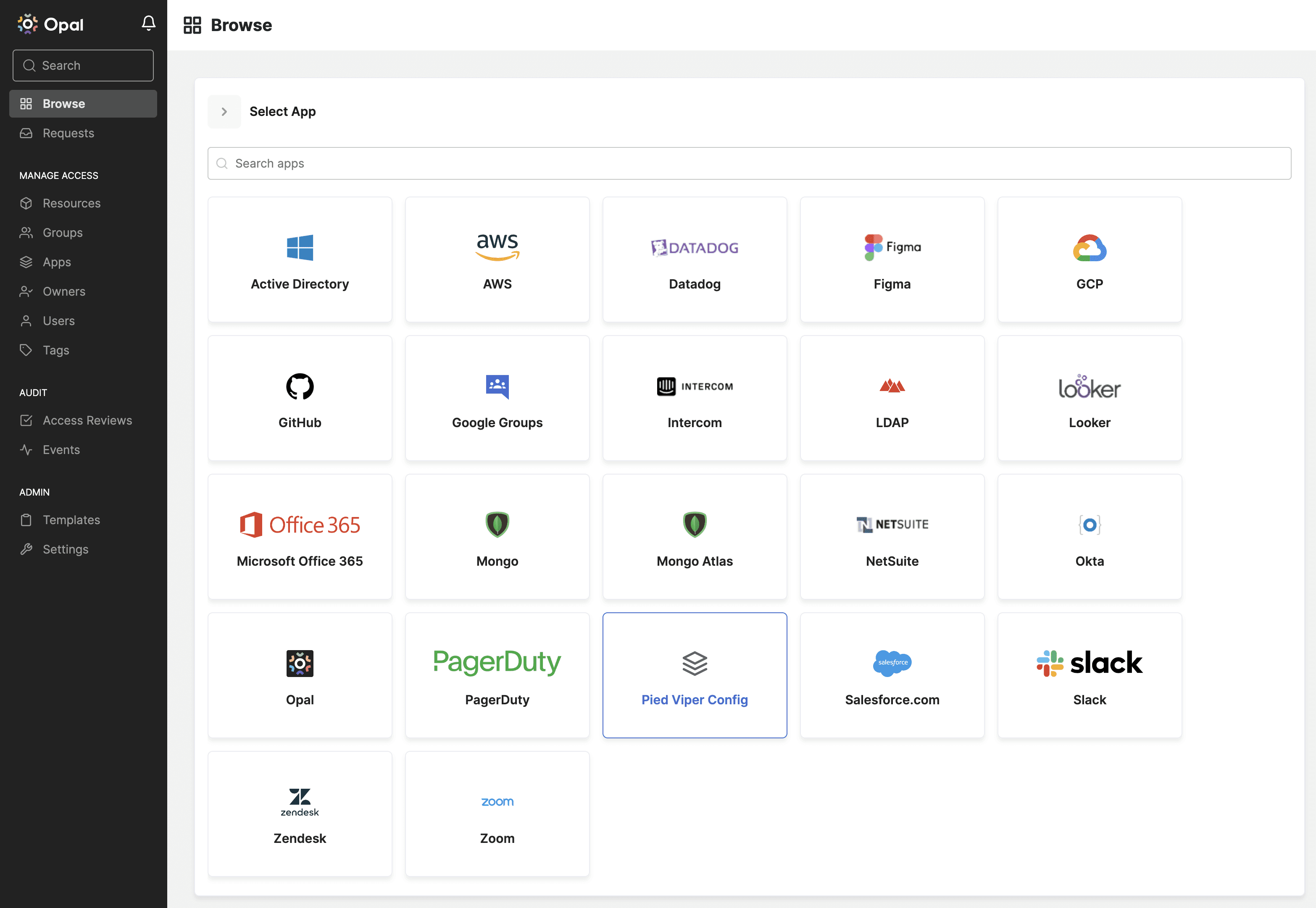
Applications: Applications would represent admin tools. In this example, we have called the internal app Piped Viper Config
Resources: These are the sub-components or functions within admin tools, such as customer impersonation, update billing and reset password. In this example, we have called these resources Gooli, Eviato, and Moolybib.
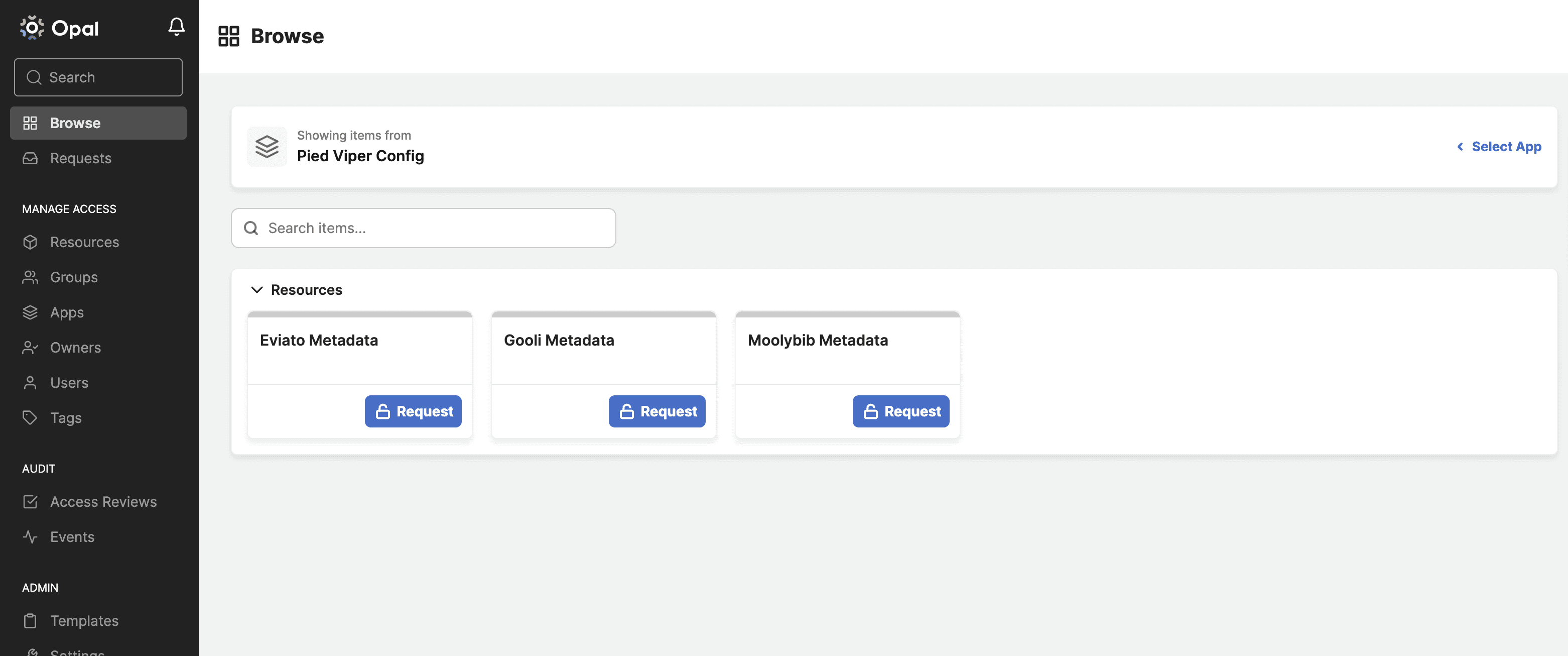
Access levels: These are additional metadata associated with the resource, in this case, the name of the individual you impersonate. These access levels will be fetched from your database in real-time and can represent any granularity, ranging from specific users or groups of users. In this example, we are requesting access to impersonate “Andrew Rishwain”

About Opal:

Opal enables companies to implement least privilege while accelerating employee productivity. Integrated with infrastructure, SaaS apps, and custom internal tools, Opal is the access management solution for IT and infrastructure teams.

Want to see it yourself? Contact sales@opal.dev or book a meeting here for a personalized demo.

‍

AI that makes continuous access decisions, with you on the dial.

AI that makes continuous access decisions, with you on the dial.

AI that makes continuous access decisions, with you on the dial.

Everything you need to know about Opal

What is Opal Security and what does it do?

Opal Security is an AI-native access platform that secures access for every identity in the enterprise, from employees and contractors to service accounts and AI agents. Security and engineering teams use Opal to grant just-in-time access, enforce least privilege, automate access reviews, and remediate identity risk in real time. Companies like Databricks, Figma, and Cloudflare run Opal to govern sensitive access.

What systems does Opal integrate with?

Opal integrates with the systems engineers and security teams already use, including Okta, AWS, GCP, Azure, GitHub, Snowflake, Databricks, Salesforce, Kubernetes, databases, and Slack. It connects to your identity provider to import users and groups, then layers granular, resource-level access control on top. Access requests and approvals can run directly in Slack.

How is Opal different from traditional IGA and IAM tools?

Legacy IGA tools mostly give you visibility and periodic reviews. Opal is a modern access platform with read-write enforcement, so it does not just surface excess access, it removes standing privilege and grants just-in-time access automatically.

Can Opal govern AI agents and non-human identities?

Yes. Opal governs non-human identities, including AI agents, service accounts, and machine identities, with the same least-privilege and just-in-time controls it applies to people. Agents can call Opal for access decisions with human oversight, and every action is logged in an audit trail, so you can see exactly what an agent did with its access.

Does Opal replace my existing identity stack?

No. Opal works on top of your existing identity stack rather than replacing it. It integrates with providers like Okta and your cloud and SaaS systems, adding granular authorization and just-in-time access without ripping out what you already run.

How fast can Opal be deployed?

Opal connects to your identity provider and core systems through native integrations, so teams typically see access visibility and working just-in-time workflows in days, not the multi-month rollouts associated with legacy IGA. You can start with a single high-risk system and expand from there.

Who is Opal's leadership?

Opal is led by CEO Howard Ting, who joined in December 2025 after serving as CEO of Cyberhaven and holding senior roles at Nutanix, Palo Alto Networks, and Redis. He has since expanded the executive team with Chief Product Officer Sameer Mehta, previously at Veza, and Chief Technology Officer Alex Pien. Opal has raised $59 million in total funding, including a recent $23 million round led by Greylock and Battery Ventures, and is used by security and engineering teams at companies like Databricks, Notion, Cloudflare, and CoreWeave.

0

FAQ

See. Encode.

→ Enforce.

© 2026

See. Encode.

→ Enforce.

© 2026

See.

→ Enforce.

Encode.

© 2026